Not every options trade works exactly as planned. Some trades expire worthless, premium is collected, and the capital can be reused the following week. Other trades require adjustments.
Recently, Netflix (NFLX) became one of those trades in my portfolio. What started as a simple weekly bull put credit spread eventually turned into a longer-dated cash-secured put after several adjustments.
This article walks through the actual trade timeline, why I made the adjustments, and what this experience taught me about rolling challenged options positions.
The Original NFLX Trade
The original NFLX position was opened on May 14, 2026 as a weekly bull put credit spread.
The original trade was:
- NFLX weekly bull put credit spread
- Short strike: 84
- Long strike: 79
The idea was simple. I wanted to test whether NFLX could become a second weekly premium generator alongside NVDA.
At the time, NVDA was already the main engine of weekly options income in the portfolio. Adding NFLX seemed like a reasonable way to diversify premium generation instead of relying on one stock.
For readers unfamiliar with this type of trade, see: Bull Put Spread Strategy: A Complete Beginner's Guide.
When the Credit Spread Became Challenged
Initially, the NFLX experiment worked reasonably well. I was able to complete a few weekly trades and collect premium.
Then NFLX started moving lower.
As the stock declined, the original credit spread became increasingly uncomfortable. This is where trade management becomes more important than trade entry.
I had several choices:
- Close the position and accept the loss
- Roll the spread forward
- Widen the spread
- Convert the trade into a cash-secured put
I initially tried to manage the spread structure. But after NFLX continued weakening, I decided to convert the position into a cash-secured put.
For more on this type of adjustment process, see: How to Manage a Credit Spread When the Trade Moves Against You.
First Major Adjustment: From Credit Spread to Cash-Secured Put
At the beginning of June, NFLX had already fallen significantly, and the original weekly credit spread no longer looked like the best structure.
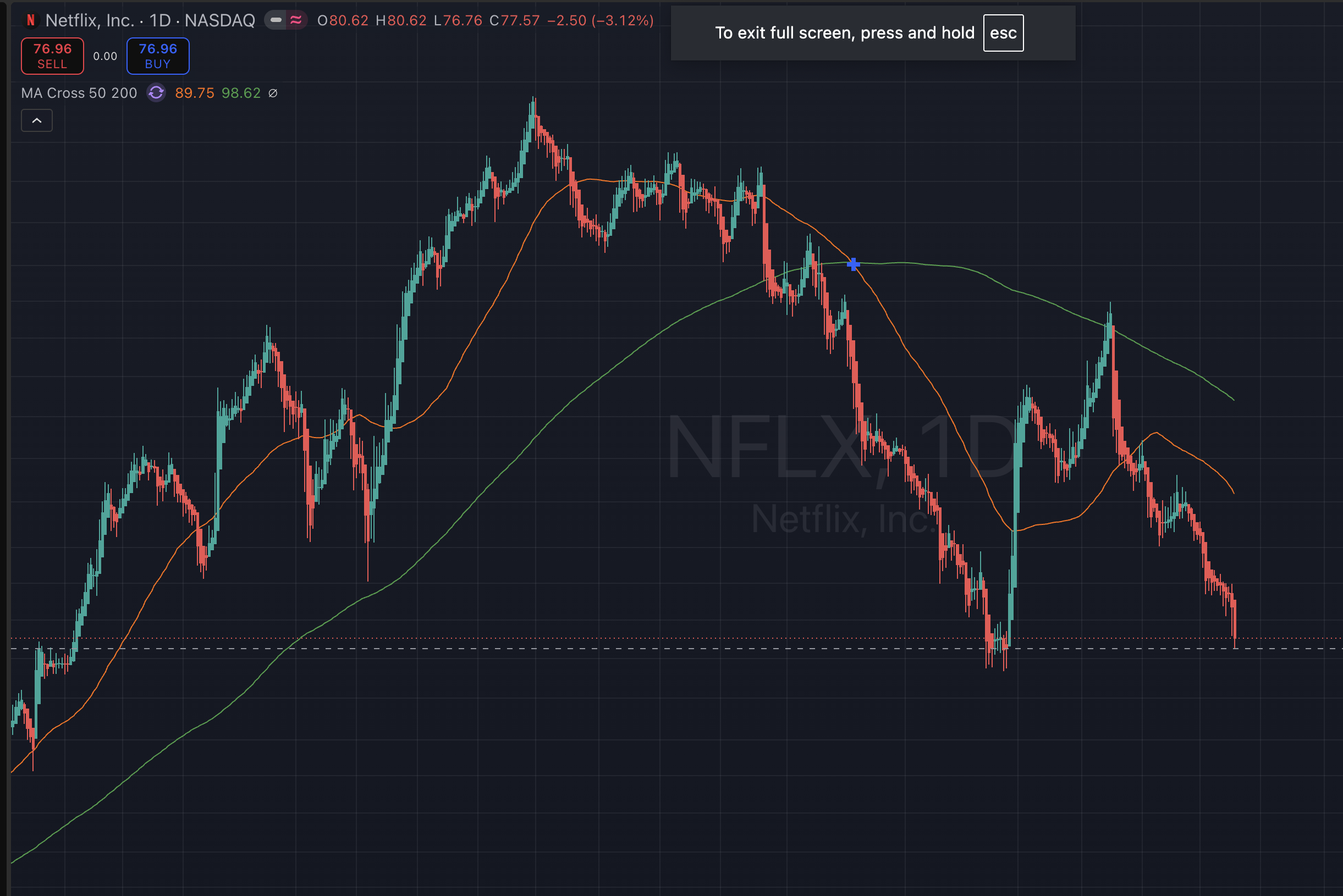
Instead of continuing to defend the short-term spread, I rolled the position into a longer-dated cash-secured put.
The adjusted position became:
- NFLX Aug 21, 2026 expiration
- $76 cash-secured put
This was already a meaningful improvement compared with the original 84 short strike.
By rolling out to August and lowering the strike to 76, I reduced the potential assignment price and collected additional premium.
The trade-off was obvious: more capital became tied up, and the position required more patience.
For a broader explanation of this strategy, see: Cash-Secured Puts Explained: A Complete Guide for Income Investors.
Second Adjustment: Rolling Further Down and Out
NFLX continued to weaken after the first adjustment. The stock dropped below $80, and I did not want to wait passively until the August expiration.
Instead, I made another proactive adjustment.
I rolled the position again:
- From Aug 21, 2026 expiration
- To Jan 15, 2027 expiration
- Strike reduced from $76 to $70
This second roll significantly improved the position from a strike-price perspective. The original trade started with an 84 short strike. After multiple adjustments, the current strike is now 70. That is a major reduction in potential assignment price.
Total Premium Collected and Break-Even
Across the original trade and the subsequent adjustments, total premium collected now stands at approximately $234.
If assigned at the current $70 strike, the estimated break-even price would be approximately: $67.66 per share
That changes the trade significantly. This is no longer the same risk profile as the original 84/79 weekly credit spread.
The trade has evolved into a potential long-term stock acquisition at a much lower effective price. That does not make the trade risk-free. It simply means the adjustments improved the position compared with where it started.
Assuming the position expires worthless, the total return would be about 3.34% over 245 days. While not an outstanding return on capital, it would still represent a positive outcome from a trade that required multiple adjustments.
Was This Catching a Falling Knife?
This is the uncomfortable question. At first glance, rolling a declining NFLX position further into the future may look like catching a falling knife.
NFLX has been a troubled stock in 2026. The company missed expectations, investor sentiment weakened, and the stock lost significant value year-to-date. In that environment, rolling a losing position can easily become dangerous if the trader is simply refusing to accept a loss.
That is why I try to separate hope from actual trade management.
A roll should improve at least one of the following:
- Lower strike price
- Additional premium collected
- Better break-even price
- Improved probability of success
In this case, the rolls lowered the strike from 84 to 76 and then from 76 to 70, while also increasing total premium collected.
That does not guarantee success, but it does improve the trade structure.
The Cost of Rolling
Rolling is not free. Even when a roll generates additional premium, there are still costs. The biggest cost in this case is time.
What started as a weekly trade may now remain open until January 2027. That means capital is tied up for much longer than originally planned.
There is also opportunity cost. Capital used to support this NFLX position cannot be used elsewhere unless the trade is closed or adjusted again. This is why rolling should never be viewed as a magic fix. It is a tool, not a solution by itself.
Why NFLX May Not Be Ideal for Weekly Options Income
One lesson from this trade is that NFLX may not be the best fit for my weekly options income strategy. The original idea was to use NFLX as a second weekly premium generator alongside NVDA.
In practice, the stock has shown how quickly a premium-rich trade can turn into a longer-term management problem when sentiment changes. NFLX may still be a tradable stock, and the current position may still work out over time.
But based on this experience, I am less convinced that NFLX deserves a permanent role in my weekly credit spread strategy.
This is an important reminder: not every liquid options stock belongs in every portfolio.
Credit Spreads vs Cash-Secured Puts in Practice
This trade also shows why I continue using both credit spreads and cash-secured puts. Credit spreads are useful because they define risk and require less capital.
Cash-secured puts are useful because they provide more flexibility, especially if I am willing to own the stock at a lower effective price.
In this NFLX case, the trade started as a credit spread but eventually became a cash-secured put as part of the adjustment process.
I compare both strategies in more detail here: Bull Put Spread vs Cash-Secured Put: Which Is Better for Small Accounts?.
Key Lessons From the NFLX Adjustment
- A weekly trade can turn into a long-term position quickly.
- Rolling should improve the trade, not simply delay a loss.
- Lowering the strike price matters more than defending the original trade idea.
- Cash-secured puts require more capital and patience than credit spreads.
- Not every stock is suitable for weekly options income.
Final Thoughts
The NFLX trade is still open, so this is not a victory lap. The final outcome remains uncertain. NFLX could recover, move sideways, or continue declining.
What matters for now is that the position has been adjusted from a short-term weekly credit spread into a lower-strike, longer-dated cash-secured put with a much improved break-even level.
That is the reality of options trading. The best trades are clean and easy.
The most educational trades are usually messy.
This one has become messy, but it also provides a useful case study in trade management, rolling, capital allocation, and knowing when a stock may not fit a weekly income strategy.
Related Reading
- Bull Put Spread Strategy: A Complete Beginner's Guide
- Cash-Secured Puts Explained: A Complete Guide for Income Investors
- Bull Put Spread vs Cash-Secured Put: Which Is Better for Small Accounts?
- How to Manage a Credit Spread When the Trade Moves Against You
- Can You Really Earn $100 Per Week Selling Options?
Disclaimer
This article reflects personal portfolio activity and is provided for educational and informational purposes only. It should not be considered investment advice, financial advice, tax advice, or a recommendation to buy or sell any security, option, derivative, or financial instrument. Options trading involves risk and may not be suitable for all investors. Past performance does not guarantee future results.
Join the OptionsBrew newsletter
Get practical notes on options income, trade adjustments, and risk management.