One of the biggest misconceptions about options trading is that every trade has only two outcomes:
- You win.
- You lose.
In reality, experienced options traders often have more choices. A position can be adjusted, rolled, transformed, or completely restructured depending on how the trade develops.
Today I'd like to walk through a real example from my own portfolio. Not because the trade was spectacular. But because it demonstrates an important lesson - good trade management can be more valuable than a good trade entry.
The Original Trade
On May 14, I opened a bullish credit spread on Netflix (NFLX). The goal was straightforward collect premium while keeping risk defined. Like many credit spread traders, I expected the stock to remain above my short strike through expiration.
Original trade:
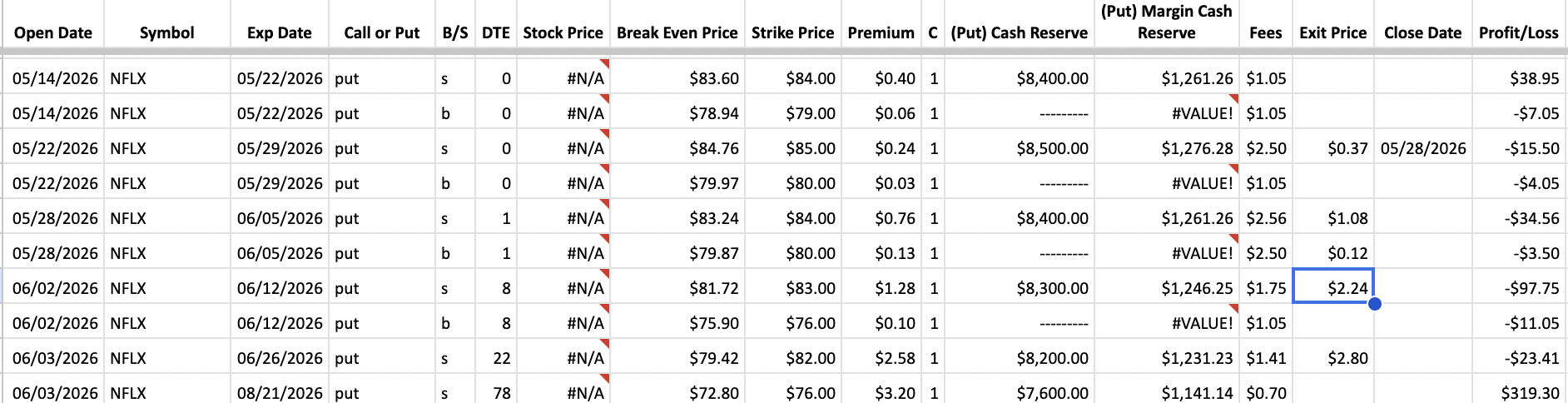
NFLX May 22, 2026 $84/$80 Bull Put Credit Spread opened for a $0.34 credit.
The spread expired worthless, allowing us to keep the full premium. On May 22, I immediately opened a new weekly position:
NFLX May 29, 2026 $85/$80 Bull Put Credit Spread opened for a $0.17 credit.
This time, however, the trade came under pressure as NFLX declined below the short $85 strike. What initially appeared to be another routine premium collection trade suddenly required active management to avoid assignment risk and potential losses at expiration.
Unfortunately, markets don't always cooperate. As the position developed, I had to make a decision.
Should I:
- Accept the loss?
- Roll the position?
- Adjust the strikes?
- Transform the trade entirely?
Adjustment #1: Extending Time
One of the first tools available to options sellers is time. When a trade moves against you, additional time can provide flexibility.
After several weeks of successfully trading NFLX credit spreads, I was finally tested on May 28 when the position moved against me. Instead of taking a loss, I rolled the spread down and out for a net credit, extending the duration of the trade and reducing risk while collecting additional premium.
Rather than closing the position immediately, I adjusted the structure and extended the duration of the trade. This allowed me to continue collecting premium while giving the position more room to work.
Adjustment #2: Converting to a Calendar Spread
As market conditions evolved few days latter, I made another adjustment. Instead of maintaining the original credit spread structure, I converted the position into a calendar spread.
I rolled the short put to the June 26 expiration for additional time and credit, while leaving the long put unchanged with its June 12 expiration.
Why? Because my objective had changed.
At this point I was less interested in defending the original trade and more interested in creating a position that could continue generating premium while reducing immediate risk. This is an important distinction.
Many traders become emotionally attached to their original trade idea. I prefer to focus on the best opportunity available today.
Adjustment #3: Becoming a Cash-Secured Put Seller
Eventually the position evolved again. The final structure resembled a cash-secured put with a significantly lower strike price.
A few moments later, NFLX dipped below my strike price, and I decided to roll the position even further out in time, this time moving to a significantly lower strike price to give the trade more room and improve the probability of success.
The original risk level had been reduced from the equivalent of an $84 strike down to approximately $76.
At the same time, the various adjustments generated additional premium along the way.
The Result
Over approximately 99 days, the combined adjustments generated about $2.11 per share in premium.
More importantly, the process reduced the strike price at which I would potentially be willing to own the stock.
The trade became less about defending the original position and more about improving my risk-reward profile.
The Lesson
Most educational content focuses on entries. Buy here. Sell there. Pick this strike. Choose that expiration.
But options trading doesn't stop after the order is filled. Real-world options trading is often about managing uncertainty.
- Sometimes the best adjustment is to close the trade.
- Sometimes it's to roll.
- Sometimes it's to completely transform the position into something new.
The key is understanding that every adjustment should improve the position relative to your current outlook and risk tolerance.
The goal is not to be right. The goal is to continuously improve the trade you have.
That's what this Netflix position taught me.
Join the OptionsBrew newsletter
Get practical notes on options income, trade adjustments, and risk management.