Portfolio Value: $11,210
Weekly Change: +0.62%
YTD Return: +7.69%
Options Premium Collected: $171.20
As of March 20, 2026, our options income portfolio increased by +0.62%, closing at $11,210.
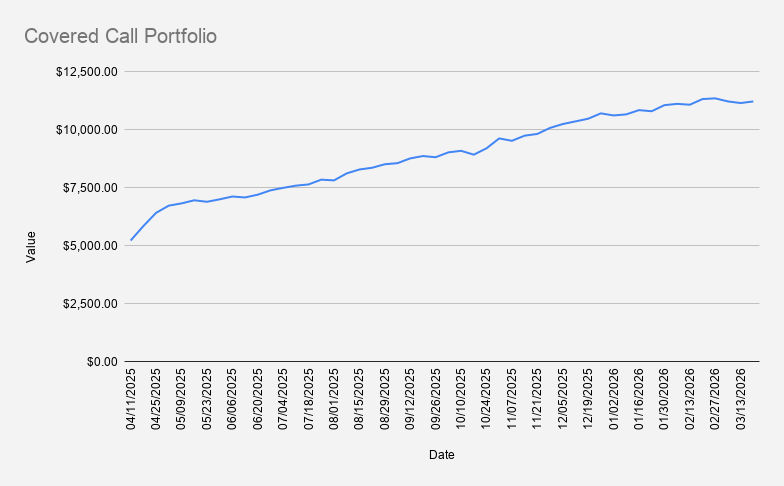
On a year-to-date basis, the portfolio is up 7.69%, outperforming both the S&P 500 (+4.72%) and NVDA (-7.55%) over the same period.
Most of the week was relatively quiet. No major adjustments were required, and several existing positions continued moving in our favor. On Friday, after previous positions expired worthless, I opened two new credit spreads to continue generating premium income.
A Quiet Week Ends With New Credit Spreads
One of the advantages of selling options is that not every week requires constant action.
This week was largely about patience. Existing positions behaved well, allowing previously sold options to expire worthless. Once those positions closed, I opened new trades to continue generating income.
The new positions were:
- NVDA Mar 27, 2026 165/155 Bull Put Credit Spread
- 2x BMY Jun 18, 2026 50/46 Bull Put Credit Spread
Credit spreads remain one of my preferred strategies because they allow me to define risk while using significantly less capital than cash-secured puts.
If you're unfamiliar with the strategy, start here: Bull Put Spread Strategy: A Complete Beginner's Guide
Current Options Positions
- NVDA Mar 27, 2026 165/155 Bull Put Credit Spread
- 2x BMY Jun 18, 2026 50/46 Bull Put Credit Spread
- PFE May 15, 2026 25 Cash-Secured Put
- NVDA Nov 20, 2026 $120 Covered Call
The portfolio continues to combine three core options income strategies:
- Credit spreads for weekly premium generation
- Cash-secured puts for selective stock acquisition
- Covered calls on long-term holdings
Why I Occasionally Buy McDonald's Stock
This week I also added another 0.1 shares of McDonald's (MCD).
Long-time readers may recognize this habit.
Occasionally, when visiting McDonald's with my daughter, I purchase a small amount of MCD stock. It serves as a simple way to reinforce a basic investing lesson: sometimes it makes sense to become a small owner of businesses you regularly use and understand.
I wrote more about this approach here: Why I Buy MCD Stock After Visiting McDonald's
Of course, even seemingly stable businesses carry risks. During our visit, the kids jokingly discussed suing the restaurant over improperly sized chicken nuggets. While obviously not serious, it served as a humorous reminder that every business faces unexpected risks.
As investors, we should never assume any company is completely immune from problems.
Reinvesting Premium Into Long-Term Holdings
This week was what I would call a "booster week."
Our previous Bristol-Myers Squibb (BMY) credit spread expired worthless, allowing us to open a new position while collecting additional premium.
Part of that premium was reinvested into the portfolio:
- 1 additional share of BMY
- 0.1 additional shares of NVDA
- 0.1 shares of MCD
The BMY purchase increased our total position to eight shares.
BMY is a dividend-paying company, making it a useful complement to a portfolio that remains heavily concentrated in growth-oriented technology stocks.
Meanwhile, the additional NVDA purchase increased our core holding to approximately 101.5 shares.
This reflects one of the key principles behind the portfolio:
Use options premium not only for income, but also to gradually increase ownership of productive assets.
$171 in Options Premium Income
This week generated $171.20 in options premium income.
That makes it one of the strongest premium-generating weeks in the portfolio's history.
Realistically, I do not expect this pace to continue consistently.
Options income is rarely linear. Some weeks produce exceptional results, while others generate very little premium.
For that reason, I focus less on individual weeks and more on long-term averages.
I discuss realistic income expectations in greater detail here: Can You Really Earn $100 Per Week Selling Options?
Margin Debt Reduction Progress
One of the primary objectives of the portfolio remains reducing margin debt while maintaining a core holding of 100 NVDA shares.
Current margin debt stands at approximately -$3,557.
At a sustained pace of $171 per week, the debt could theoretically be eliminated within roughly 20 weeks.
However, I do not expect premium generation to remain anywhere near that level consistently.
The broader goal remains unchanged:
- Reduce margin debt gradually
- Avoid unnecessary risk
- Preserve core positions
Whether that happens during 2026 or extends into 2027 is ultimately less important than maintaining a sustainable process.
Looking Ahead
The primary position to monitor next week is:
- NVDA Mar 27, 2026 165/155 Bull Put Credit Spread
If the trade comes under pressure, the plan remains unchanged:
- Roll forward when appropriate
- Prefer collecting additional credit
- Prioritize portfolio stability over short-term results
For readers interested in trade adjustments and rolling strategies: How to Manage a Credit Spread When the Trade Moves Against You
Key Takeaway
This week demonstrated how options income can serve multiple purposes simultaneously.
Premium income generated cash flow, financed additional stock purchases, expanded dividend-producing positions, and helped move the portfolio closer to its debt-reduction goals.
The objective isn't maximizing income during any single week. The objective is creating a repeatable system that can continue generating income and building ownership over time.
Related Reading
- Bull Put Spread Strategy: A Complete Beginner's Guide
- Bull Put Spread vs Cash-Secured Put: Which Is Better for Small Accounts?
- Cash-Secured Puts Explained: A Complete Guide for Income Investors
- How to Manage a Credit Spread When the Trade Moves Against You
- Can You Really Earn $100 Per Week Selling Options?
- Why I Buy MCD Stock After Visiting McDonald's
Disclaimer
This trade journal reflects personal portfolio activity and is provided for educational and informational purposes only. It should not be considered investment advice, financial advice, tax advice, or a recommendation to buy or sell any security, option, derivative, or financial instrument. Options trading involves risk and may not be suitable for all investors. Past performance does not guarantee future results.
Join the OptionsBrew newsletter
Get practical notes on options income, trade adjustments, and risk management.