One of the biggest misconceptions in options trading is that every trade should work quickly. Sometimes they do. Sometimes they don't.
And occasionally a trade that started as a simple weekly credit spread turns into a position that requires months of management and patience. That's exactly what happened with my Netflix (NFLX) trade.
How the NFLX Trade Started
The position originally began on May 14, 2026 as a straightforward weekly bull put credit spread.
The initial trade was:
- Short 84 Put
- Long 79 Put
At the time, the setup looked reasonable. NFLX was trading considerably higher, implied volatility was attractive, and I expected the position to expire worthless.
Unfortunately, the stock continued to weaken. Rather than immediately realizing a loss, I chose to manage the position.
If you're unfamiliar with this process, see: How to Manage a Credit Spread When the Trade Moves Against You.
From Credit Spread to Cash-Secured Put
As NFLX continued falling, I eventually converted the trade into a cash-secured put.
The first major adjustment moved the position to:
- August 21, 2026 expiration
- $76 strike price
This lowered the potential acquisition price significantly while giving the stock more time to recover. Later, as NFLX continued trading below expectations, I rolled the position again.
The trade moved from:
- January 15, 2027 $70 Put
to:
- June 15, 2027 $66 Put
The Latest Roll
The adjustment was executed by:
- Buying back the January 15, 2027 $70 Put for approximately $5.10
- Selling the June 15, 2027 $66 Put for approximately $5.40
The result was a net credit of approximately $0.30, or $30 per contract.
While the premium received was relatively small, the real benefit came from reducing the strike price. The adjustment lowered my potential purchase price by another $4 per share, improving downside protection by approximately $400 per contract.
After accounting for all premiums collected throughout the life of the trade, the current break-even price is approximately:
$63.04 per share
That figure is calculated as: $66 strike price minus approximately $2.96 of cumulative premium collected.
When a Weekly Trade Becomes a Long-Term Position
One lesson from this trade is that options traders should never assume every position will remain short-term. What started as a weekly credit spread has now become a position extending nearly one year into the future.
Some traders would view this as a failure. I view it differently. The trade is still manageable. The strike price has improved significantly. The break-even has improved significantly. And assignment would occur at a price far below where the original trade started. That said, this adjustment comes with a cost.
Capital remains tied up. Management flexibility becomes limited.
And because the position occupies a meaningful amount of buying power, I am intentionally avoiding opening additional trades in other names. For now, my primary active options strategy remains weekly NVDA credit spreads.
See: Bull Put Spread Strategy: A Complete Beginner's Guide
Is NFLX a Falling Knife?
Perhaps. That is the uncomfortable reality. NFLX has struggled throughout 2026. Growth expectations have slowed.
Subscriber growth is no longer the story it once was. Competition from Disney, Amazon, Apple, YouTube, and numerous streaming platforms remains intense. The market is increasingly questioning how much future growth remains available.
As a result, the stock has lost a substantial portion of its value.
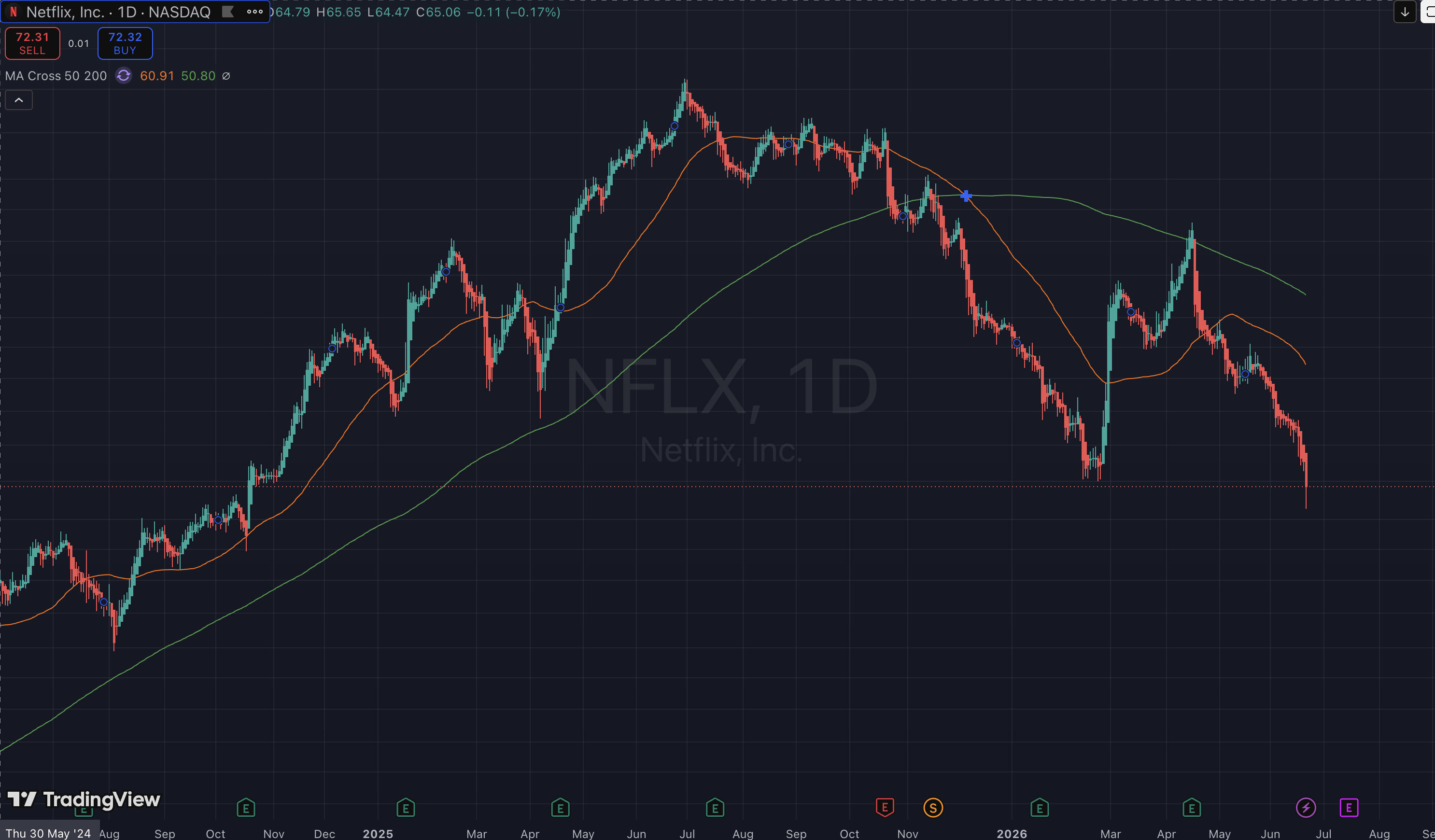
Technically speaking, NFLX currently trades below both its 50-day and 200-day moving averages.
While some investors may argue the worst is already behind us, I would not rule out additional downside.
Potential support levels exist near:
- $66
- $58
Levels not seen since late 2024.
The July Earnings Report Matters
One event I'm watching closely is the upcoming earnings report scheduled for July 17. Part of the recent weakness may simply reflect the market pricing in disappointing results. Markets tend to anticipate bad news before it becomes official.
Whether those fears prove justified remains unknown. If earnings disappoint, additional downside is possible.
If expectations have become too pessimistic, the stock could recover sharply. Either outcome would significantly influence this trade.
Lessons Learned
This trade reinforced several lessons that apply far beyond NFLX.
1. Don't Chase Premium
The original objective was income generation, not maximizing premium. Higher premium almost always means higher risk.
See: Cash-Secured Puts Explained
2. Always Be Comfortable Owning the Stock
If you sell puts, there is always a possibility of assignment. Never sell puts on a company you would not be willing to own.
3. Rolling Is Not Magic
Rolling does not eliminate risk. It simply changes the structure of the risk.
Every roll should improve either:
- Strike price
- Break-even
- Probability of success
- Premium collected
4. Avoid Overconcentration
One consequence of this NFLX position is reduced flexibility. Because capital is committed to managing the trade, fewer resources are available for new opportunities.
This is one reason I generally prefer defined-risk credit spreads over naked or cash-secured positions.
See: Bull Put Spread vs Cash-Secured Put
Final Thoughts
At this point, the NFLX trade is no longer a weekly options trade. It has effectively become a long-term position management exercise.
The latest roll lowered the strike from $70 to $66, improved the break-even to approximately $63.04, and generated additional premium.
While the stock could still decline further, the trade is considerably safer today than when it was first opened.
The experience serves as a useful reminder that successful options trading is often less about finding perfect entries and more about managing imperfect situations. Sometimes the best lesson comes from the trades that refuse to cooperate.
Related Reading
- Cash-Secured Puts Explained
- How to Manage a Credit Spread When the Trade Moves Against You
- Bull Put Spread vs Cash-Secured Put
- Can You Really Earn $100 Per Week Selling Options?
Disclaimer
This article is for educational purposes only and should not be considered investment advice. Options trading involves substantial risk and may not be suitable for all investors.
Join the OptionsBrew newsletter
Get practical notes on options income, trade adjustments, and risk management.